Antigua has been written about so many times that it can be hard to separate what's legitimately worth your time from the generic checklist items. The city is a UNESCO World Heritage Site—a base for some of the best volcano hiking in Central America, as well as the center of a coffee and cacao-growing region that produces internationally recognized products. It draws enough tourists that the difference between an authentic afternoon and a rushed experience mostly comes down to how you structure your time.
The city rewards slow movement and early mornings. Most of the best things here require neither a guide nor a large budget, just some knowledge in advance of where to go and when. This list focuses on the viewpoints, experiences, and day trips that consistently hold up after multiple visits.
For travelers arriving by rental car from Guatemala City, Enterprise Guatemala's Antigua office is located at 1ra Avenida Norte No. 9B and operates Monday through Friday, 9:00 AM to 5:00 PM, and Saturday, 9:00 AM to 1:00 PM. Leave your car there and explore the colonial center on foot.
What Should You Do First in Antigua?
Get oriented before you dive into anything. Antigua's grid layout makes it navigable once you understand the system: avenidas run north to south, calles run east to west, and the Parque Central anchors everything.
- Walk the Parque Central. The Cathedral of Santiago and the Palacio de los Capitanes Generales frame the square on two sides, and the fountain at its center has been a gathering point since the colonial era. Arrive without an agenda and take a break here before moving on—the park affords you a bit of time to observe the city before you start filling your itinerary.
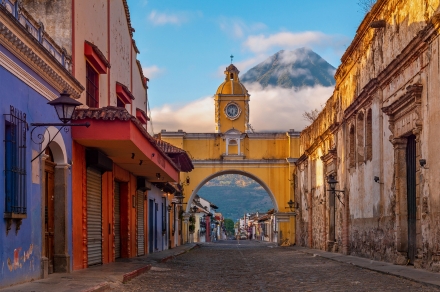
- Find the Santa Catalina Arch. Located two blocks north of the park on 5a Avenida Norte, this colonial arch is Antigua's most photographed landmark and a useful reference point for navigating the north end of town. Go early, before tour groups and tuk-tuks crowd the street.
- Walk to Cerro de la Cruz. North of the city center, a short uphill walk leads to Cerro de la Cruz, the hilltop viewpoint crowned by a large stone cross that dates all the way back to 1930. The view from the summit looks south over Antigua's entire grid, with Volcán de Agua rising behind the city. Go at sunrise if you can manage it; the air is clearer and the light is better than at any other time of day. The area is normally patrolled by tourist police between 8:00 AM and 4:00 PM.
What Are the Best Cultural Experiences in Antigua?
A Coffee Tour with De La Gente
Guatemala is one of the premier coffee-producing countries in the world, and the farms that supply some of its best beans sit on the slopes immediately surrounding Antigua. De La Gente (DLG) is a non-profit organization that runs community-based coffee tours out of San Miguel Escobar, a village located about 10 minutes from the city center.
The DLG coffee tour is led by the coffee growers themselves, not hired guides. You walk through their fields, learn every step of the process from cultivation to processing to brewing, and finish the tour with a cup made from beans picked from the same plants you just walked through. The three-hour tour runs at 9:00 AM and 2:00 PM and costs $40 USD per person. Reservations must be made at least 24 hours in advance.
For travelers who want to go even deeper, DLG also offers a combined coffee tour and cooking class on the same day, where a local family guides you through preparing Guatemala's traditional pepián dish and tortillas on a wood cookstove.
Chocolate Workshop at ChocoMuseo
Cacao is as native to Guatemala as coffee, and ChocoMuseo, located at 4a Calle Poniente No. 8 directly in front of the Parque Central, offers hands-on workshops that explain the full bean-to-bar process in the context of Mayan history and colonial trade routes.
The Bean to Bar Workshop runs approximately two hours and takes participants through hand-grinding cacao, tempering chocolate, and molding finished bars to take home. The workshop draws on the same cacao traditions that predate European arrival in the region. While walk-ins are possible, it’s recommended you book ahead of time, as sessions tend to fill quickly.
Ruins of Colonial Convents and Churches
Antigua has more ruined colonial churches per square kilometer than anywhere else in Central America, and the good news is most of them are either free or very low cost to enter. The ruins of La Recolección, the Convento de Las Capuchinas, and the Cathedral of Santiago are the three most substantial. The Cathedral ruins, adjacent to the active church on the east side of the Parque Central, include an underground crypt. Las Capuchinas, on 2a Avenida Norte and 2a Calle Oriente, is the best-preserved convent complex in the city and worth an hour of unhurried exploration.
Volcano Experiences
Pacaya: The Accessible Introduction
Pacaya is the entry point for anyone who wants to stand on an active volcano without committing to a serious expedition. Located about 70 km southeast of Antigua, the trailhead is roughly an hour to 90 minutes by car. The hike from the park entrance to the lava fields takes one to two hours at a moderate pace and climbs roughly 400 meters along the way.
What you’ll find at the top is hardened lava flows, fumaroles venting sulfurous gas, and hot spots warm enough to roast marshmallows directly on the rock. A certified guide is mandatory inside the national park. OX Expeditions, based in Antigua since 2004, runs a reliable day trip that includes shuttle transport from Antigua, guide fees, and gear.
Acatenango: The Serious Option
Acatenango is a different category of experience entirely. At 3,976 meters (13,045 feet), the overnight hike to Acatenango's summit puts you at a high-altitude campsite with a direct sightline to Volcán Fuego, which erupts visibly every 15 to 45 minutes. Watching Fuego throw lava and ash columns into the night sky from a distance of just a few kilometers makes for a memorable experience.
The hike is demanding, however. It requires a full day of ascent through cloud forest and volcanic terrain, spending the night in a mountain hut or tent, followed by a summit push before sunrise. OX Expeditions offers the Acatenango overnight hike year-round and is one of the most reputable operators running this route. Allow at least 48 hours in Antigua to acclimatize before attempting it.
CONRED, Guatemala's national disaster reduction agency, monitors volcanic activity and issues alerts when conditions change. Make sure to check their current bulletins before any volcano trip.
Day Trips from Antigua
Chichicastenango Market
Every Thursday and Sunday, the highland town of Chichicastenango (about 90 minutes northwest of Antigua by car) hosts one of the largest indigenous markets in Central America. Vendors selling textiles, ceramics, wooden masks, jade, and produce fill the market streets and the steps of the Santo Tomás Church, where Maya and Catholic traditions merge openly in the incense smoke.
Driving yourself gives you full control over arrival time; getting there by 8:00 AM, before tour shuttles arrive, is important if you want to avoid a crowded tourist circuit.
Lake Atitlán
The drive from Antigua to Panajachel, the main gateway town on Lake Atitlán's north shore, takes approximately two to two and a half hours, bypassing Guatemala City entirely. Lake Atitlán sits in a volcanic caldera and is flanked by three major cones: San Pedro, Tolimán, and Atitlán. Few road descents in Guatemala prepare you for the first full view of the lake opening up below Sololá.
Having a rental car at this point means you get to avoid shared shuttle schedules and can depart Antigua early, spend a full day at the lake, and then return at your own pace. Enterprise Guatemala's vehicle options include sedans and SUVs; for the Antigua-to-Atitlán run, a sedan handles the paved highway without difficulty.
What Practical Things Should I Know About Getting Around Antigua?
Tuk-tuks are the default short-distance transport. The three-wheeled motorized tuk-tuks that crisscross Antigua are cheap, fast, and useful for reaching neighborhoods like Cerro de la Cruz that are a longer walk from the center. There are no running meters, so make sure you negotiate a reasonable price before boarding.
Park outside the center. Antigua's cobblestone streets are narrow, and parking in the colonial core is genuinely difficult. If you're arriving by rental car from Guatemala City or elsewhere, it’s more practical to park at or near your hotel and go on foot. Luckily the center is compact; most major sites are around a 15-minute walk from the Parque Central.
Carry cash. Many restaurants, markets, and entrance fees are quetzales-only. ATMs are available near the Parque Central, but they can run out on busy weekends and during Semana Santa.
Semana Santa means plan differently. If your visit falls during Holy Week (the week before Easter), Antigua hosts the most elaborate Semana Santa processions in Latin America. Streets are carpeted with colored sawdust alfombras, and religious processions run for days. It’s spectacular to witness but extremely crowded to navigate. Book accommodation months in advance and expect traffic into the city to be significantly delayed.
Frequently Asked Questions
Do I need a car to visit Antigua Guatemala?
Not for Antigua itself. The city center is compact and easily covered on foot or by tuk-tuk. A rental car becomes valuable when you plan day trips: to Chichicastenango market, Lake Atitlán, or Pacaya Volcano. Having your own vehicle lets you set your own departure times and avoid shared shuttle schedules, which matters when you want early access to sites before crowds arrive.
Is Antigua safe for travelers?
Antigua is one of Guatemala's most visited cities and receives a high volume of international tourists year-round. The tourist police (DISETUR) maintain a visible presence in the historic center. Standard precautions apply: keep valuables out of sight, avoid displaying expensive cameras or phones unnecessarily, and use tuk-tuks or taxis after dark rather than walking unfamiliar streets. ASISTUR, Guatemala's tourist assistance line, is reachable at 1500 from any Guatemalan phone, 24 hours a day.
What is the best time of year to visit Antigua?
The dry season, November through April, offers the most reliable weather for outdoor activities and volcano hikes. January through March tends to be the clearest. The rainy season (May through October) brings daily afternoon showers, but mornings are usually clear, and Antigua remains fully functional. Semana Santa, typically in March or April, is the most culturally significant time to visit, but keep in mind it’s also the most crowded.
Can I do a volcano hike as a day trip from Antigua?
Yes. Pacaya is a half-day trip from Antigua, with organized day tours leaving in the morning and returning by early afternoon. Acatenango requires an overnight stay on the mountain but departs from and returns to Antigua. Both are accessible with a rental car if you prefer to drive to the trailhead independently, though a certified guide remains mandatory inside both national parks. Contact Enterprise Guatemala to arrange a vehicle that suits your itinerary.
What should I know about Antigua's climate and altitude before I arrive?
Antigua sits at approximately 1,530 meters (5,020 feet) above sea level, which gives it a mild, spring-like climate year-round but also means a few practical realities travelers arriving from sea level should account for:
- Temperatures drop sharply after dark. Daytime highs typically range from 20°C to 25°C (68°F to 77°F), but evenings cool down fast. Pack a layer for any outdoor dinner or late walk, and a proper jacket if you plan to hike.
- Mild altitude symptoms are possible on arrival. At 1,530 meters, most travelers adjust within a day without difficulty. Headaches and fatigue on the first night are not unusual, especially if you flew in from sea level the same day. Hydrate well and avoid heavy alcohol on arrival.
- Volcano hikes go significantly higher. Acatenango's summit is at 3,976 meters, Pacaya at 2,552 meters. OX Expeditions recommends at least 48 hours in Antigua before attempting Acatenango specifically.
- Rainy season afternoons require a plan. From May through October, rain arrives most afternoons, usually between 2:00 and 5:00 PM. Morning activities run in clear conditions; outdoor plans that push into late afternoon should have a backup.