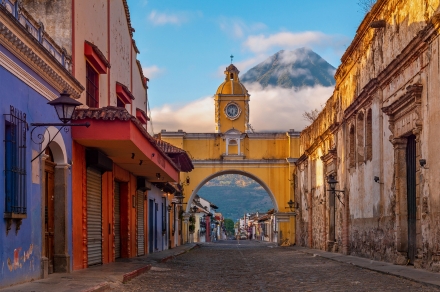
Antigua Guatemala is the country's most visited city, and for good reason. Ringed by three volcanoes (Agua, Fuego, and Acatenango), its colonial core is a UNESCO World Heritage Site filled with well-preserved Spanish Baroque architecture, cobblestone streets, and one of Central America's most vibrant cultural calendars. It is also the most practical base in Guatemala for a self-drive itinerary: close to the airport, well-connected to the main highway network, and surrounded by day-trip destinations within 90 minutes in any direction.
For travelers picking up a rental car from Enterprise Guatemala at La Aurora Airport or the Antigua office itself, the city is both a natural starting point and a base worth understanding before you arrive. This guide covers the driving logistics: how to reach Antigua from La Aurora International Airport, how to navigate and park once you are there, and which vehicle makes sense for your itinerary.
Getting to Antigua by Car
The drive from La Aurora International Airport to Antigua covers approximately 45 km and takes 45 minutes to 1 hour under normal traffic conditions. The route is well-established and fully paved throughout.
From the airport in Zona 13, head west on Calzada Roosevelt through Zona 11. Calzada Roosevelt feeds directly onto CA-1, the Inter-American Highway, heading northwest. Continue on CA-1 and exit at San Lucas Sacatepéquez. From there, RN-10 descends into the Panchoy Valley and delivers you into Antigua from the north. The descent offers the first view of the city set against the volcanoes — one of the better arrival moments in the country.
The main complication is Guatemala City traffic. Rush hours run from approximately 5:00 to 8:00 AM and 4:00 to 7:30 PM on weekdays, and congestion on Calzada Roosevelt can add 30 to 60 minutes to the drive. Flights arriving in the early afternoon will typically clear the city without issue. Flights arriving after 4:00 PM put you directly in the evening rush hour with no practical bypass.
Enterprise Guatemala's La Aurora Airport office is on the third floor of the airport parking building and is open daily from 5:00 AM to 11:59 PM, so vehicle pickup works regardless of arrival time.
Coming from Other Directions
If you are arriving from the west via Lake Atitlán or Quetzaltenango, you will approach on CA-1 from the Chimaltenango direction. The Antigua exit signage appears before San Lucas coming from that direction. GPS navigation handles this reliably, but download offline maps before heading into the highlands, since signal can drop briefly on some stretches.
Coming from the south or Pacific coast, the route runs through Escuintla and joins CA-1 before the Antigua turnoff. This is less common for first-time visitors but straightforward in daylight.
An alternative northern approach drops into Antigua via San Lucas from above, offering a more scenic and less-trafficked descent from CA-1. It is narrower and windier than the standard RN-10 route and not recommended after dark or in heavy rain, but it is a reasonable option during daylight in dry conditions if you want to avoid the main highway interchange.
Driving Inside Antigua
Getting to Antigua is the easy part. Navigating inside it requires a different mindset.
Antigua's streets follow a colonial grid of roughly 20 blocks in each direction from Parque Central. Nearly all of them are one-way, and the direction is not always obvious from signage alone. Small arrows painted on building corners at intersections indicate which way traffic flows. Locals will honk if you enter a street heading the wrong direction, which is more helpful than it sounds.
Cobblestone is another factor. Speed limits in Antigua's built-up areas are around 20 to 30 km/h, and the streets enforce their own limit regardless of what the signs say. Driving quickly over cobblestone can damage your suspension, so slow and deliberate is the correct approach throughout.
Topes (speed bumps) also appear inside the city without much warning. They are a feature of every urban road in Guatemala, and Antigua is no exception. Even at low speeds, an unmarked tope taken too fast will make itself known. Keep your speed consistent and low, especially when entering any new block or turning from a larger road onto a side street.
A practical strategy: park the car when you arrive and stay on foot. Antigua's historic core is compact enough that most of the main ruins, markets, restaurants, and viewpoints sit within a 15-minute walk of the central plaza. The car is most useful for day trips out of the city, not for moving around within it.
Where to Park in Antigua
Parking in Antigua falls into three categories: hotel parking, private lots, and street parking.
Hotel Parking
The most convenient option by far is a hotel with secure on-site or contracted parking. Many of Antigua's mid-range and upscale hotels include parking or can arrange it nearby. Confirm availability when booking rather than assuming it exists. On-site hotel parking is particularly valuable during Semana Santa, when much of the city center closes to vehicles entirely.
Private Parking Lots
Several attended private lots (parqueos) operate in and around downtown. Hourly rates typically run Q10 to Q15, and overnight rates range from Q100 to Q200 (approximately USD 13 to 25) depending on location. These lots are the safest option for overnight parking if your hotel does not provide it. Do not leave valuables visible in the vehicle at any parking location.
Street Parking
Street parking in Antigua requires a marbete, a daily permit purchased from municipal transit agents stationed around the city. The fee for vehicles with Guatemalan plates is Q10 per day on weekdays. Vehicles with foreign plates are generally not required to purchase the permit, though this can vary. Curbs painted red indicate no parking. Blue-painted curbs are reserved for disabled access, and white-painted curbs are for motorcycles only. Blocking a garage entrance, even briefly, risks a tow.
Street parking inside the historic center is limited and fills early on weekends and during any major event or procession.
What Vehicle Do You Need for Antigua?
For the city itself, a compact or midsize sedan is the most practical choice. Antigua's streets are narrow enough that two vehicles passing simultaneously is sometimes impossible, and a smaller footprint makes navigation, parking, and maneuvering much easier.
Where vehicle choice matters more is in how you plan to use Antigua as a base. If your itinerary involves day trips to Pacaya Volcano, Iximche, or the coffee farms around Jocotenango, a sedan handles all of those routes without difficulty. If you are planning onward travel to Lake Atitlán during the rainy season, or to more remote highland destinations, an SUV becomes the better default.
It is also worth considering the type of driving you will do getting in and out of the city. The CA-1 corridor between Guatemala City and Antigua is a well-paved, two-to-four-lane highway that any vehicle handles comfortably. Where terrain starts to matter is on the secondary roads that branch off toward volcanoes, villages, and coffee-growing slopes above the city. Those routes are paved but steep, and in wet conditions a vehicle with more ground clearance gives you more confidence. If your itinerary keeps you on the main roads, a sedan is entirely sufficient. If you plan to explore the hillside fincas or push beyond the standard tourist corridors, an SUV is the right call from the start.
Enterprise Guatemala's Antigua office is located at 1ra Avenida Norte No. 9B and is open Monday through Friday 9:00 AM to 5:00 PM and Saturday 9:00 AM to 1:00 PM. The fleet includes sedans, SUVs, and pickups, none older than two years. For travelers flying into La Aurora and driving straight to Antigua, picking up at the airport and returning at the Antigua office is possible with advance booking; one-way surcharges apply.
Alternatively, travelers who plan to use the car exclusively for day trips can pick it up directly at the Antigua office, skip the airport transfer logistics entirely, and return it at the same location when their stay ends. This approach works particularly well for anyone arriving by shuttle and planning two or three excursions from the city rather than a full multi-destination road trip.
Antigua During Semana Santa: What Drivers Need to Know
Semana Santa (Holy Week) transforms Antigua in ways that affect every driver visiting during this period. The city's population can swell dramatically as processions draw visitors from across Guatemala and beyond. Streets along procession routes are closed, large sections of the center become pedestrian-only from Holy Thursday through Easter Sunday, and driving into or out of Antigua on peak days requires significant advance planning.
Specific things to prepare for:
- Book hotel parking in advance. Spots fill weeks ahead of the main days.
- Avoid driving into the center on Good Friday. Processions run through much of the grid and vehicle access is heavily restricted.
- Expect the CA-1 corridor to slow significantly from Holy Thursday through Easter Sunday, particularly on the return to Guatemala City Sunday evening.
- ATMs run short of cash in small surrounding towns during the week. Withdraw before Wednesday.
Outside of Semana Santa, Antigua's other major calendar events (including the Day of the Dead celebrations in nearby Santiago Sacatepéquez in early November) can affect local road access on specific days but do not produce the same city-wide disruption.
Practical Notes for Driving to and Around Antigua
Fuel: There are no fuel stations inside Antigua's historic center. Fill up along CA-1 before you descend into the city, or at stations on the outskirts near the San Lucas turnoff. Major brands including Shell, Puma, and Uno operate stations along the Guatemala City corridor. If you are heading out on a day trip to Pacaya or Iximche, fill up before leaving Antigua in the morning rather than counting on finding a station en route.
Speed bumps: Topes appear frequently throughout Antigua and on surrounding roads without much warning. They are often unmarked and can be severe. Keep speeds low through any urban area or small town on the approach roads.
Navigation: Waze and Google Maps both work reliably on the Guatemala City-to-Antigua route. Inside the city, GPS can occasionally route you onto one-way streets in the wrong direction or through narrow lanes that are technically accessible but practically difficult. Cross-reference with local knowledge when possible, and do not assume the fastest route suggested by your app is the most sensible one on the ground.
Emergency contacts:
- ASISTUR (tourist assistance, 24/7): 1500 from any Guatemalan phone, +502 2290-2810 from abroad
- PROVIAL (highway assistance on CA-1): +502 2419-2121
- Enterprise Guatemala (rental assistance): +502 3570-5831 or reservations@enterprise.gt
Frequently Asked Questions
How far is Antigua from La Aurora International Airport?
Approximately 45 km by road. The drive takes 45 minutes to 1 hour in normal traffic, and up to 90 minutes or more during Guatemala City rush hours (5:00 to 8:00 AM and 4:00 to 7:30 PM on weekdays). The route follows Calzada Roosevelt onto CA-1 west, then exits at San Lucas Sacatepéquez onto RN-10 into the city.
Is it difficult to drive in Antigua?
It is manageable but requires patience. The main challenges are:
- One-way streets that are not always clearly signed
- Narrow cobblestone lanes where two vehicles cannot always pass simultaneously
- Limited and competitive parking in the city center
Most visitors find it easiest to park on arrival and explore the historic core on foot.
Where should I park overnight in Antigua?
A hotel with secure on-site or contracted parking is the best option. If your hotel does not offer it, private attended lots (parqueos) charge Q100 to Q200 per night and are the safest alternative to street parking. Never leave valuables visible in a parked vehicle.
Can I pick up a rental car in Antigua rather than at the airport?
Yes. Enterprise Guatemala's Antigua office at 1ra Avenida Norte No. 9B is open Monday through Friday 9:00 AM to 5:00 PM and Saturday 9:00 AM to 1:00 PM. This is a practical option for travelers arriving by shuttle from the airport who plan to use a vehicle for day trips rather than for the airport transfer itself.
What vehicle size is best for driving in Antigua?
A compact or midsize sedan is the most practical choice for navigating the city itself. Antigua's cobblestone streets and narrow lanes make a smaller vehicle significantly easier to maneuver and park. If your itinerary includes onward travel to highland destinations or rainy-season driving on secondary roads, an SUV is the better choice for the overall trip.
Is Antigua accessible by car during Semana Santa?
It is accessible, but with significant restrictions. Much of the city center becomes pedestrian-only from Holy Thursday through Easter Sunday, and streets along procession routes are closed. Driving into Antigua on Good Friday is not recommended. Book hotel parking well in advance and plan your arrival and departure around the procession schedule.