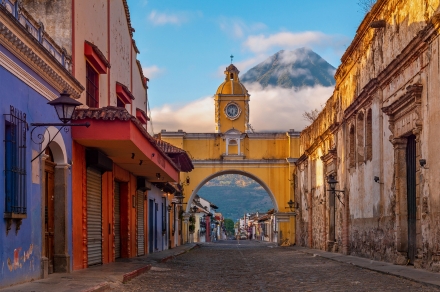
Few celebrations anywhere in Latin America match the scale of Guatemala's Holy Week — and it's not something you want to stumble into without a plan. Every year, the colonial streets of Antigua fill with towering procession floats, hand-laid sawdust carpets stretching entire city blocks, and crowds numbering in the hundreds of thousands. The tradition is recognized by UNESCO as an Intangible Cultural Heritage of Humanity.
The spectacle comes with serious logistics. Roads congest, hotel rooms disappear months in advance, and entire sections of Antigua go pedestrian-only from Holy Thursday through Holy Saturday. Whether you're flying into La Aurora and driving straight to Antigua or planning a multi-city circuit, the answers below will help you travel smarter.
Enterprise Guatemala car rentals are available at La Aurora International Airport and across Guatemala City, as well as in Antigua. Pick up your vehicle before the holiday rush and drive on your own schedule.
When exactly is Semana Santa in 2027?
Holy Week 2027 runs from Palm Sunday, March 21, through Easter Sunday, March 28. Lent starts on Ash Wednesday, February 10, and smaller Lenten processions take place in Antigua every Friday and Sunday leading up to Holy Week. Those early Cuaresma weekends offer a taste of the tradition without the peak-week crowds.
The most intense days fall between Holy Thursday (March 25) and Good Friday (March 26). Good Friday is when the largest processions move through Antigua, beginning as early as 4 a.m. and running well into the night.
Easter Sunday (March 28) shifts the mood entirely — somber processions give way to festive music, fireworks, and family gatherings. If you're driving back to Guatemala City, leave before noon. By afternoon, the return highway becomes a slow crawl as the city empties out.
What are alfombras and andas, and when can I see them?
These two elements define the visual identity of Semana Santa in Guatemala.
Alfombras are elaborate street carpets laid directly on the cobblestones along procession routes. Families spend the night before each major procession constructing them from colored sawdust, flowers, pine needles, and sometimes fruit. Some stretch an entire city block — and every one is destroyed when the procession passes over it. They're offerings, not decorations. The best time to photograph them is early morning on Good Friday, between 4 and 6 a.m., before the processions arrive.
Andas are the massive hand-carved wooden floats carried through the streets. The largest can weigh up to 8,000 pounds and require teams of 40 to 120 carriers — called cucuruchos — working in rotating shifts. On Palm Sunday and early Holy Week, cucuruchos wear purple robes; by Good Friday, they switch to black to mark the mourning of the crucifixion. Some processions last up to 18 hours.
Is Semana Santa only in Antigua, or can I see it elsewhere?
Antigua hosts the most elaborate celebrations, but Holy Week plays out across the entire country.
Guatemala City holds major processions through the Historic Centre, with alfombras and street food filling the streets alongside firecrackers and marching bands. Quetzaltenango (Xela) builds arches from aromatic corozo palm leaves for processions to pass beneath. The towns around Lake Atitlán observe the same rituals on a smaller scale — for travelers seeking the cultural immersion with fewer crowds, these communities are worth the detour.
Having a rental car in Guatemala gives you the freedom to move between locations on your own timeline. From Antigua, Quetzaltenango is roughly 2.5 hours northwest via CA-1, and the Lake Atitlán area is 1.5 to 2 hours depending on your destination. An SUV is worth considering if you plan to venture beyond the main highways into smaller lake towns.
How bad is traffic around Antigua, and when should I drive?
The RN-14 highway connecting Guatemala City to Antigua is one of the country's worst bottlenecks during Holy Week. The danger windows are Wednesday afternoon, all day Thursday, and Friday morning — the periods when visitors converge most heavily. Aim to be in Antigua by Tuesday at the latest, or early Wednesday morning at the absolute limit.
On Easter Sunday, outbound traffic back to Guatemala City peaks around midday. Leave by 10 or 11 a.m. to stay ahead of it. Travelers picking up or dropping off a vehicle at the Enterprise Guatemala City locations should factor these windows into their schedule.
For travelers splitting time between Antigua and other destinations, plan any movement on Monday through Wednesday. Once Holy Thursday arrives, staying put is the smarter call.
What's the parking situation in Antigua during Holy Week?
Street parking in the historic center disappears entirely. From Holy Thursday through Holy Saturday, procession routes block vehicle access to the colonial core, with 50 to 70 percent of central streets shifting to pedestrian-only at peak times.
Use one of the paid lots on the outskirts of town — roughly Q50 to Q100 per day (approximately $6–$13 USD) — and walk in. The Municipalidad de Antigua typically releases an official parking map ahead of Holy Week showing lot locations and pedestrian zone boundaries. Once inside, tuk-tuks run Q10 to Q20 per ride. For most of the central zone during peak days, walking is simply faster.
If you're staying in the historic center, confirm parking availability when you book. Travelers arriving from La Aurora International Airport should plan to drive directly to their accommodation before Thursday if possible, and establish a parking arrangement before the holiday closures take effect.
What should I know about businesses and ATMs during Holy Week?
Banks close from Holy Thursday through Easter Sunday — some as early as Wednesday. ATMs stay operational but lines grow long, and machines in tourist-heavy areas run dry. Withdraw enough quetzales before Holy Thursday to cover the full long weekend. Parking lots, tuk-tuks, street food, and local vendors are largely cash-only.
Most private businesses close Thursday through Sunday at minimum. If you need to handle any administrative tasks — passport renewals or document processing — take care of them at least a week before Holy Week.
Is it safe to travel during Semana Santa, and what etiquette should I follow?
Antigua is one of Guatemala's safest cities, and Holy Week brings additional security. The municipality deploys hundreds of police officers, establishes pedestrian perimeters around procession routes, and runs free shuttle buses from outlying parking areas. INGUAT — Guatemala's official tourism institute — also stations tourist assistance kiosks throughout Antigua and other major destinations during Holy Week. That said, the volume of people creates conditions for petty theft — keep bags close, avoid visible jewelry, and don't leave valuables in your rental vehicle.
For emergencies, Bomberos can be reached at 122, Cruz Roja at 128, and ASISTUR — Guatemala's tourist assistance line — at 1500 from any local phone or via WhatsApp. Enterprise Guatemala is available at reservations@enterprise.gt. For road incidents involving your rental, contact Enterprise directly and do not move the vehicle unless it poses an active safety risk.
On the cultural side, a few points of etiquette matter:
- Never step on an alfombra before the procession arrives
- Keep a respectful distance from floats and avoid blocking procession routes
- Ask permission before photographing individuals, especially during emotional moments
- Dress modestly near churches and during religious ceremonies
- Wear comfortable shoes — cobblestone streets and long procession days add up fast
The processions aren't a performance for tourists. They're a living tradition passed down through families and religious brotherhoods for five centuries. Visitors of every background are welcome — arriving with that awareness tends to make the experience considerably richer.